
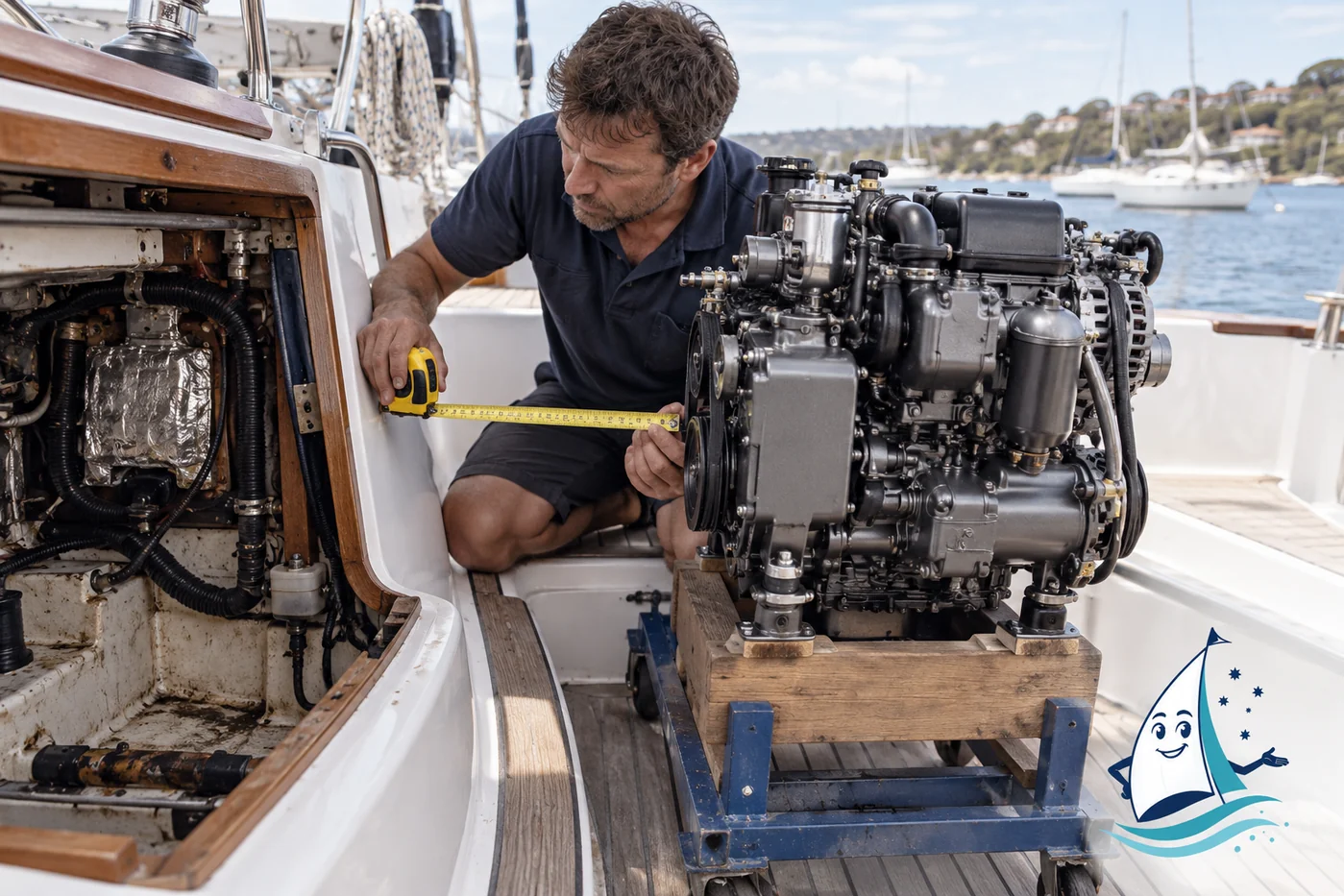
1. Define the need before the product
Write down the problem before choosing an engine: unreliable starting, repeated downtime, poor manoeuvring, limited parts support or a diagnosed mechanical fault. Give the mechanic your engine model, gearbox or saildrive, propeller details, service history and intended use. An engine’s age or hours alone do not settle whether replacement is appropriate. Ask for a diagnosis and a scope for each credible option.
2. Compare the credible options
Compare maintaining the existing installation, a defined repair or rebuild, and a complete repower. Ask what each option retains and what warranty covers the finished work. Treat electric propulsion as a separate system study: intended motoring endurance, charging access, space, weight, operating conditions and emergency plans all need review. A familiar horsepower number is not a complete specification.
3. Check the complete installation
- Have the installer inspect the yacht and document fit, service access and the removal route before you buy equipment.
- Ask which engine beds, mounts, gearbox, shaft or saildrive, propeller and controls can be retained, and on what evidence.
- Confirm the proposed cooling, exhaust, fuel supply, ventilation and electrical arrangements with the installer.
- Coordinate alternator and starter-battery arrangements with any lithium-house-bank project; give both contractors the same system brief.
4. What the all-in quote should cover
Compare written Australian dollar quotes for the same scope. Ask whether GST is included, how long pricing is valid and what remains an estimate.
- Engine package, controls, instruments and exactly which accessories are included.
- Removal, lifting, yard time, disposal and any interior removal or reinstatement.
- Mounting or structural work, drivetrain work and agreed repairs discovered during access.
- Commissioning, trial, registration of applicable warranty, follow-up checks and taxes; require exclusions and variation approval in writing.
Equipment-only pricing is not an installed-cost estimate. Record unknown costs separately and agree approval for variations before work proceeds.
5. Check the handover, not just the invoice
Agree the acceptance and commissioning evidence before work starts. Use the installer’s appropriate test procedure; this is an owner’s handover checklist, not instructions to perform technical tests yourself.
- Obtain the installer’s documented commissioning results and an agreed operational trial; resolve any incomplete tests.
- Have the installer demonstrate controls, alarms, routine checks, shutdown and service access.
- Collect the final installation details, manuals, serial numbers and first-service requirements.
6. Budget for ongoing ownership
Arrange the first service and any follow-up alignment or installation checks the installer specifies. Keep the trial record with the engine documents. Confirm local parts and technician support for the places you intend to cruise, and ask what spares and consumables are appropriate for that particular installation.
Common buying mistakes
A cheap engine-only quote can omit the work needed to make it function in your yacht. Do not assume more power solves a handling problem, that a replacement fits the existing beds, or that an existing propeller is suitable. Ask for the assessment behind each retained component.
WORKED PLANNING EXAMPLE
Illustrative decision: a buyer receives one quote for an engine in a crate and another for a commissioned installation. They first rewrite both quotes against the same scope—removal, access, drive, controls, trial and follow-up—before comparing totals. The preferred option may change once the omissions are priced.
THE OWNER’S FIELD GUIDE
Work through the decision in detail
Use these discussions before requesting a quote. Bring the yacht’s records, your survey findings and a clear description of the trips you want to make.
- Write a propulsion brief, not a shopping list
- Build an evidence file before asking repair versus replacement
- Removal access can change the project
- Give the propulsion and electrical contractors one plan
- Compare diesel and electric against a real journey
- Commissioning should produce an evidence pack
- Budget for downtime and the first season
OWNER’S FIELD GUIDE · 01
Write a propulsion brief, not a shopping list
Describe the boat as it will be used: loaded for weekends, a season on the coast or longer passages. Include how often you motor, how long you expect to motor continuously, and where reliable servicing will be available. A boat that leaves a marina for afternoon sails has a different ownership problem from a yacht preparing for remote cruising. Neither use automatically determines a particular engine. It determines the questions the installer must answer.
Give the contractor photographs of the installation, model and serial details, known repairs and the symptoms you want resolved. Record whether each symptom was observed, reported by a seller or inferred from a survey. “I need a bigger engine” is a proposed solution. “I cannot reliably manoeuvre in my usual berth” is a problem that can be investigated across controls, propulsion, condition and technique. A useful brief keeps those two statements separate.
OWNER’S FIELD GUIDE · 02
Build an evidence file before asking repair versus replacement
Ask the mechanic to explain what has actually failed, what remains uncertain and which additional checks would change the recommendation. A quotation based only on a telephone description may reasonably contain qualifications. Keep those qualifications visible when comparing it with a contractor who has inspected the yacht. Request the cost and purpose of any investigation before authorising it.
Make a retained-components list for a repair, rebuild and repower proposal. Each may leave different parts of the installation untouched. Put the proposed warranty alongside that list: whose workmanship is covered, which equipment is covered, where the work can be supported and what records are required. “Rebuilt” and “new” are not complete descriptions of the finished propulsion system. The decision is easier when you can show what you will own at the end of each option, including its remaining uncertainty.
OWNER’S FIELD GUIDE · 03
Removal access can change the project
Before the yacht is booked into a yard, ask the installer to walk through the route from the existing engine bed to the lifting point. Identify what must be temporarily removed and who will put it back. Companionway joinery, steps, sound insulation and accommodation finishes may all create work that is absent from an engine-package price. The owner should not devise lifting arrangements; the responsible professionals need to plan them.
Record whether the quoted labour includes protection of the interior, removal of fluids, disposal, transport, storage and reinstatement. Ask what happens if access reveals an unrelated defect. A useful contract distinguishes agreed work from newly discovered work and requires approval before a variation. Photographing the cabin before work starts can also help everyone agree the expected condition at handover. An apparently more expensive quote may simply describe these responsibilities more honestly.
OWNER’S FIELD GUIDE · 04
Give the propulsion and electrical contractors one plan
Repowering and changing the house electrical system are often sold as separate jobs. Ask both contractors to identify the connections between them: starting arrangements, alternator charging, monitoring and the supplies needed by engine controls. Record which professional will confirm the final configuration. A gap between two otherwise competent scopes can become the owner’s problem at commissioning.
Keep optional equipment separate from the essential installation. A new monitor or upgraded alternator may be useful, but each change should have a reason and an identified dependency. Ask what the yacht can safely do if the house bank is unavailable, and have the professionals document the expected behaviour rather than assuming the old behaviour survives the refit. The finished drawings and operating notes should describe the installed yacht, not a generic example from a brochure.
OWNER’S FIELD GUIDE · 05
Compare diesel and electric against a real journey
If electric propulsion interests you, write out an actual motoring requirement rather than comparing an electric motor’s label with the old diesel. Discuss duration, reserve, expected conditions, recharging opportunities and the effect of other electrical loads with a competent propulsion designer. Request the assumptions behind any range estimate. A demonstration in calm water may answer different questions from a passage plan involving uncertain conditions.
Ask how installation weight and volume are distributed, what charging infrastructure is realistically available, and how support works away from the installation port. Include any generator or backup arrangement in the proposal rather than treating it as a later detail. Electric and diesel options should be compared as complete supported systems serving the same intended use. This guide does not prescribe a conversion or a universal power equivalence.
OWNER’S FIELD GUIDE · 06
Commissioning should produce an evidence pack
Before installation begins, agree who will carry out commissioning, who will operate the yacht during the trial and what records will be handed over. Ask the installer to define the relevant checks for that equipment and installation. The owner’s role is to understand the evidence and the operating instructions, not to improvise technical tests. Record any checks that cannot be completed because of conditions or access and set a date for their completion.
The handover pack should make it possible for another suitable technician to understand the installation later. Include product identification, the final scope, manuals, recorded settings where relevant, commissioning results, warranty information and service requirements. Ask for a demonstration of routine owner checks and access. If a regular crew member will operate the engine, involve them in the handover instead of relying on one person to remember everything.
OWNER’S FIELD GUIDE · 07
Budget for downtime and the first season
An engine project affects the sailing calendar as well as the bank account. Ask what must arrive before the yard slot is confirmed, what would interrupt the schedule and where the yacht will remain during a delay. Include accommodation or travel only if it applies to you, but do not ignore repeated trips to an interstate yard. Keep the reserve separate from the contractor’s base price so it remains clear what is committed and what is available for uncertainty.
Once the yacht returns to use, retain a simple log of dates, hours and observations to share at the first service. Follow the installer’s specified follow-up process, including any checks required after initial operation. Discuss problems promptly through the agreed contact rather than accepting persistent abnormal behaviour as something a new installation must simply settle into. The purpose of the first-season plan is to close the project properly, not leave the final ten per cent unresolved.
MAKE A SHORTLIST
Which scope fits your yacht?
Ask the relevant specialist which of these routes is credible for your yacht. Compare the whole result, including the parts you would retain.
PAUSE AND ASK FOR EVIDENCE
Red flags in the upgrade proposal
These are reasons to clarify the scope or seek specialist assessment. They do not establish that a particular product or contractor is unsuitable.
“It only needs a service” without a diagnosis
A service quote does not establish why an engine overheats, loses power or starts poorly.
Your next step: Ask a marine mechanic to diagnose the reported symptoms and separate repairable faults from the case for replacement.
The replacement quote ends at the engine
Removal access, beds, mounts, exhaust, cooling, controls and drivetrain work can change the scope.
Your next step: Request an itemised installed quote with retained components, assumptions and the person responsible for each interface.
No supported parts or service plan
A low purchase price may come with uncertain local support or long waits for critical parts.
Your next step: Ask who will support the exact model in your cruising area and how warranty work is arranged.
A successful start is presented as the entire acceptance test
Starting at the berth does not demonstrate the whole propulsion installation under its agreed operating conditions.
Your next step: Agree professional commissioning, an appropriate trial and the written records before approving the scope.
ILLUSTRATIVE OWNER SCENARIO
How the decision changes in practice
An owner has three proposals: a limited repair, a rebuild and a replacement engine. Rather than asking which is cheapest, they create three columns for diagnosis confidence, components retained, access work, warranty, trial and downtime. The repair quote excludes a suspected ancillary issue; the rebuild quote excludes removal; the repower quote includes commissioning but not cabin reinstatement. The owner asks for those differences to be priced or explicitly excluded. They then compare the resulting project cost with how long they expect to keep and use the yacht. No universal percentage rule selects the winner. The useful outcome is a choice whose assumptions can be explained, with the remaining uncertainties assigned to someone.
A fictional planning example, not a report about a particular yacht, owner or contractor.
6 QUESTIONS FOR THIS TOPIC
Engine & propulsion: FAQs
Does low engine age mean I should keep it?
Age is one part of the history. Ask what the diagnosis, maintenance record, installation and support situation say. A recent engine with an unresolved installation problem and an older well-understood engine present different decisions; neither is settled by the calendar alone.
Should I increase horsepower while the engine is out?
Ask the propulsion specialist what problem that change would solve and what else it affects. Do not approve a power increase as a free improvement without reviewing the complete installation. Manoeuvring and motoring complaints deserve a diagnosis before a larger package is selected.
Can I keep the existing gearbox or propeller?
Possibly, but the proposal must identify them and explain compatibility. Ask who has assessed the retained component and whether its condition has been checked. Keeping equipment is a scope decision, not a default assumption that should disappear into small print.
What if the cheaper quote excludes commissioning?
Ask for the missing work to be priced and for responsibility to be assigned. Compare a finished, documented installation with another finished installation. If a supplier cannot provide the same scope, keep the difference explicit in the comparison rather than comparing the bottom lines.
Will a repower pay for itself when I sell?
Do not use an assumed resale increase to justify an unaffordable project. Ask a relevant broker about the local market if resale matters, but plan the purchase around the benefit to your ownership and the complete expense. Equipment expenditure and sale value are different measures.
What should I do with an unresolved trial item?
Record it, the reason it remains unresolved, the person responsible and the agreed next step. Discuss its effect on use with the installer. Avoid treating an invoice or the end of a yard booking as evidence that every part of the installation has been accepted.
Manufacturer reference
Consult the current manual for the exact chosen model. This reference illustrates the planning issues; it is not a brand endorsement or confirmation of Australian compliance. Research checked 6 October 2026.
YOUR INSTALLER BRIEF
Prepare your engine & propulsion enquiry
Saved only in this browser. Print a copy before clearing browser data. These notes stay with this equipment guide on this device; nothing is sent to a contractor.