
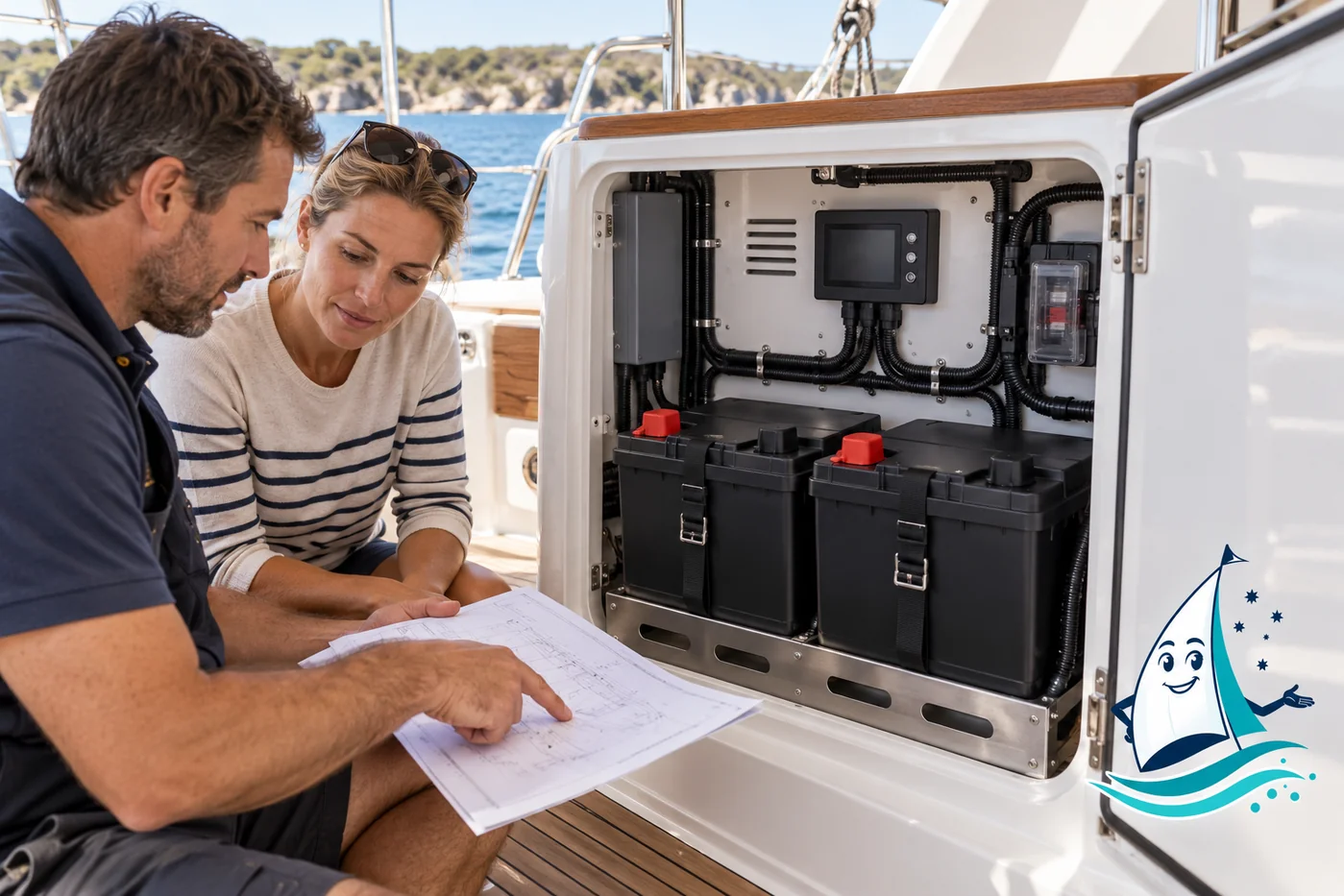
1. Define the need before the product
Start with measured or reasonably estimated daily consumption, peak loads, charging opportunities and how long you want to remain away from shore power. Separate house loads from engine starting and any other critical circuits. List what you actually run—fridge, lights, instruments, autopilot, pumps and optional appliances—rather than choosing a battery by the available locker space.
2. Compare the credible options
Compare retaining a healthy existing bank, replacing it with a suitable conventional bank, and a designed lithium iron phosphate (LiFePO4) house system. Compare usable energy and the complete installation, not just the advertised amp-hours. Batteries with different nominal voltages cannot be compared on amp-hours alone. Ask your designer to document the usable limits for the selected product and intended duty.
3. Check the complete installation
- Identify every charging source: alternator, shore charger, solar controller and any generator or wind system. Ask the designer to confirm compatibility and control of each.
- Confirm the selected battery-management system (BMS), supported batteries, protection strategy and response to a battery disconnect. Do not treat a built-in BMS as proof that the entire yacht installation is compatible.
- Ask how alternator loading, temperature and charging control will be managed; an existing alternator should not be assumed suitable unchanged.
- Document mounting, environmental limits, cable routes, isolation, circuit protection, monitoring and the separation of starting and house systems.
- Have the installer address applicable Australian requirements and the insurer’s information needs for the specific design. Avoid generic charge settings copied from a different battery.
4. What the all-in quote should cover
Compare written Australian dollar quotes for the same scope. Ask whether GST is included, how long pricing is valid and what remains an estimate.
- Batteries plus required BMS, control interfaces, enclosure or mounting changes.
- Compatible charging changes, monitoring and the wiring/protection/isolation work specified by the designer.
- Drawings, labels, installation labour, disposal of the previous bank and commissioning.
- Any costs for alternator work, shore-power changes, insurer documentation and owner training; separate optional upgrades.
Equipment-only pricing is not an installed-cost estimate. Record unknown costs separately and agree approval for variations before work proceeds.
5. Check the handover, not just the invoice
Agree the acceptance and commissioning evidence before work starts. Use the installer’s appropriate test procedure; this is an owner’s handover checklist, not instructions to perform technical tests yourself.
- Obtain a final system drawing and recorded configuration for the exact installed products.
- Have the installer verify charging from each source and explain alarms, controlled shutdown and restoration using the manufacturer’s procedure.
- Have normal and expected peak loads assessed, and confirm what remains available after a house-bank shutdown.
- Learn how to isolate the system and interpret the monitor; retain a labelled operating guide aboard.
6. Budget for ongoing ownership
Follow the battery maker’s storage and temperature instructions. Keep the approved settings and component versions with the yacht records. Have unexplained alarms or shutdowns investigated instead of repeatedly resetting them. Reassess the design before adding a large inverter, electric cooking or other high-demand equipment.
Common buying mistakes
“Drop-in” is a product description, not a compatibility assessment for your yacht. A bigger bank does not create more charging energy. A phone app is not a substitute for documented protection and control. Never bypass a BMS or protective device to keep an appliance running.
WORKED PLANNING EXAMPLE
Illustrative planning exercise: a crew estimates 1,200 Wh of daily consumption and wants two days between dependable charging opportunities. That is 2,400 Wh of load energy before system losses and design reserve. They take the load list to a specialist, who determines the appropriate usable storage, charging and protection. This arithmetic does not specify a battery or safe installation.
THE OWNER’S FIELD GUIDE
Work through the decision in detail
Use these discussions before requesting a quote. Bring the yacht’s records, your survey findings and a clear description of the trips you want to make.
- Separate energy, power and charging
- Define the house bank and critical circuits
- Compare products through their supported systems
- Treat the alternator as a separate conversation
- Inspect the installation space before paying for batteries
- Choose monitoring that answers an owner question
- Plan the first month as a verification period
OWNER’S FIELD GUIDE · 01
Separate energy, power and charging
Energy describes how much work the system must supply over time; power describes the rate at which it is demanded. A bank that can supply a modest load for a long time is not automatically suitable for a large short load. Equally, a system able to start a demanding appliance may still lack the energy for a full day at anchor. Keep both questions in the brief.
Build a load record with appliance, measured or estimated watts, hours used, whether it is essential, and the confidence of the figure. For intermittent equipment, estimate actual running time rather than assuming it runs continuously. Keep occasional conveniences separate from navigation and ordinary living loads. Then write down when charging is genuinely available. The designer can turn these observations into a specification; an amp-hour target chosen before this work risks solving the wrong problem.
OWNER’S FIELD GUIDE · 02
Define the house bank and critical circuits
Make a list of what is currently connected to each battery arrangement and have the installer verify it. Old yachts can contain additions that are not obvious from the panel labels. Ask the professional to distinguish engine starting, house services and any circuits requiring special treatment. This is an investigation and documentation task, not an invitation to rearrange wiring yourself.
Discuss the expected result of losing the house bank. Which information, communications and operating functions remain available, and which stop? The answer depends on the yacht and the agreed design. Ask for a simple owner explanation alongside the technical drawing. Knowing this behaviour before installation helps prevent an owner from interpreting a protective shutdown as an instruction to bypass protection. It also lets the crew prepare sensible operating responses with professional guidance.
OWNER’S FIELD GUIDE · 03
Compare products through their supported systems
A battery offer should identify the exact product family, supported management arrangements, permitted configuration and required accessories. Ask the installer which documentation confirms that the proposed combination is supported. Do not assume batteries from the same brand—or products described with similar chemistry—share the same interfaces and limitations. A product change during procurement should be reviewed as a design change.
The comparison should include monitoring, protection, charging control, support and replacement availability. A low battery price may depend on reusing equipment that has not yet been checked. Conversely, a complete proposal may contain optional features you do not need. Ask the supplier to separate the required system from convenience features and explain each item’s role. The final owner documents should identify the installed products clearly enough that a future repair does not accidentally substitute an incompatible component.
OWNER’S FIELD GUIDE · 04
Treat the alternator as a separate conversation
Give the electrical installer and the engine specialist the same list of existing equipment and the same intended use. Ask how charging will be controlled, what limits apply, and what happens when the battery system asks charging to stop. The required solution is product- and installation-specific. This guide deliberately does not provide a generic wiring diagram or a universal charging setting.
Clarify who supplies and commissions any additional charging equipment, who confirms the engine-side work and who records the completed arrangement. If one quote excludes the alternator while the other excludes the house bank, a named person still needs to own the interface. Ask how the system behaves at the engine speeds and operating patterns relevant to your yacht. A theoretical maximum output is not a promise of sustained charging in everyday use.
OWNER’S FIELD GUIDE · 05
Inspect the installation space before paying for batteries
Have the proposed location reviewed for mounting, environment, service access, cable routes and the selected product’s limits. The locker that held the old bank is a starting point for the conversation, not evidence that the new arrangement belongs there. Ask how someone will inspect labels, reach the approved isolation points and replace a component later without dismantling unrelated joinery.
Record any changes in weight and distribution for the relevant professional to assess. Ask the installer to explain how equipment will be protected from the conditions expected in that space. Keep diagrams, labels and operating notes in the quote. A beautifully finished compartment is not a complete handover if nobody can identify the isolation or explain an alarm. The goal is an installation the crew can understand within their competence and a technician can service efficiently.
OWNER’S FIELD GUIDE · 06
Choose monitoring that answers an owner question
Before adding screens or remote apps, decide what you need to know: current consumption, charging contribution, remaining usable energy as estimated by the system, and alarms requiring action. Ask what each display measures, what it estimates and what its limitations are. An attractive percentage can become misleading if the owner does not understand the system’s setup and calibration requirements.
Have the installer demonstrate normal use and explain the approved response to warnings. Keep essential operating instructions accessible without relying on an internet connection or a particular person’s phone. If remote monitoring is fitted, clarify account ownership and who is allowed to change settings. Monitoring is useful when it supports decisions; it should not become a reason to alter protective parameters without understanding the approved design.
OWNER’S FIELD GUIDE · 07
Plan the first month as a verification period
After professional commissioning, compare real consumption with the assumptions in your brief during ordinary use. Keep a simple log of nights aboard, major appliances, charging opportunities and any unexpected behaviour. Share it with the installer if the system does not meet the agreed purpose. Avoid changing several settings or adding new loads before the cause of a discrepancy is understood.
Keep storage instructions with the yacht’s lay-up checklist. Ask what the owner should do before a period away, what should remain powered and what inspection is appropriate on return. There is no single storage instruction for every lithium installation. If your cruising plan changes from weekends to extended passages, revisit the load and charging assessment rather than assuming the original system was designed for unlimited growth.
MAKE A SHORTLIST
Which scope fits your yacht?
Ask the relevant specialist which of these routes is credible for your yacht. Compare the whole result, including the parts you would retain.
PAUSE AND ASK FOR EVIDENCE
Red flags in the upgrade proposal
These are reasons to clarify the scope or seek specialist assessment. They do not establish that a particular product or contractor is unsuitable.
“Drop-in replacement” is the entire design explanation
The battery sits within a charging and distribution system. Physical fit alone does not establish compatibility.
Your next step: Request a design covering the BMS, every charging source, retained equipment and the treatment of critical circuits.
Alternator charging is left for somebody else
Unassigned work at the engine-to-battery interface can undermine the complete project.
Your next step: Name the contractor responsible and request their documented compatibility and protection plan before ordering.
The seller cannot identify the exact battery or BMS
You cannot reliably check limits, support or installation requirements from an unlabelled generic description.
Your next step: Obtain traceable model details, manufacturer documentation and the local support arrangements for the proposed system.
More capacity is quoted without an energy brief
Stored capacity, peak power and replenishment are different planning questions.
Your next step: Provide a normal-day and high-demand-day load list and ask the designer to show how the whole system meets them.
ILLUSTRATIVE OWNER SCENARIO
How the decision changes in practice
A couple plans to add a watermaker and an electric galley appliance after buying lithium batteries. Their first quote prices only the bank. They instead create a present-day load list and a separate future-load list. The installer explains which changes can be supported now, which require additional charging or protection, and which would mean redesign. The couple chooses a defined first stage with documented expansion limits. Their acceptance test is not simply that the monitor turns on: it is that the installed system performs its agreed role, the charging sources are commissioned, protective behaviour is understood, and the crew has a usable operating guide.
A fictional planning example, not a report about a particular yacht, owner or contractor.
6 QUESTIONS FOR THIS TOPIC
Lithium house batteries: FAQs
Is a built-in BMS enough?
It is one part of a product’s protection, not a statement about the whole yacht. Ask how every charging source and load interacts with the selected battery and what external equipment the supported design requires. The answer should refer to the exact model documentation.
Can I compare batteries just by amp-hours?
Only with the voltage and relevant usable limits understood. For owner planning, express energy consistently and let the designer specify the operating limits. Do not assume the full nominal label is available for every intended duty or that two banks with the same amp-hours are equivalent.
Will more battery capacity fix weak solar charging?
It may extend the time before a deficit becomes obvious, but it does not create charging energy. Measure the consumption and charging balance first. The appropriate change could involve loads, charging, storage or a combination, depending on the intended use.
Can I keep my shore charger?
Ask the installer to verify the exact charger, supported settings, controls and integration. A selectable lithium label is not a complete review of the yacht’s system. Record the approved configuration and any conditions under which the equipment can be retained.
What do I ask my insurer?
Describe the proposed equipment and professional installation, and ask what information, assessment or documentation they require for your policy. Do this before work is committed where possible. Do not assume a general statement about lithium represents the terms of your actual cover.
What if a supplier substitutes a battery model?
Treat it as a proposed variation. Ask the designer to confirm compatibility, configuration and any changes to accessories or warranty before accepting it. Keep the final component list consistent with the drawings and operating information supplied at handover.
Manufacturer reference
Victron: lithium system design and BMS selection (product-specific) ↗
Consult the current manual for the exact chosen model. This reference illustrates the planning issues; it is not a brand endorsement or confirmation of Australian compliance. Research checked 6 October 2026.
YOUR INSTALLER BRIEF
Prepare your lithium house batteries enquiry
Saved only in this browser. Print a copy before clearing browser data. These notes stay with this equipment guide on this device; nothing is sent to a contractor.
Plan the connected systems
Solar panels & charging
Match collection, control and charging opportunities to your daily load.
Inverter, shore power & AC appliances
Decide which appliances are worth the energy and installation changes.
Watermaker & freshwater capacity
Balance daily water demand with energy, installation and ongoing care.