
1. Define the need before the product
Record drinking, cooking, washing and shower demand for the actual crew. Compare tank capacity and filling opportunities with the time you expect to spend away from reliable water supplies. A watermaker adds capability and maintenance; it does not remove the need for stored water and a fallback plan. Decide whether the expected use justifies fitting one before comparing catalogue output.
2. Compare the credible options
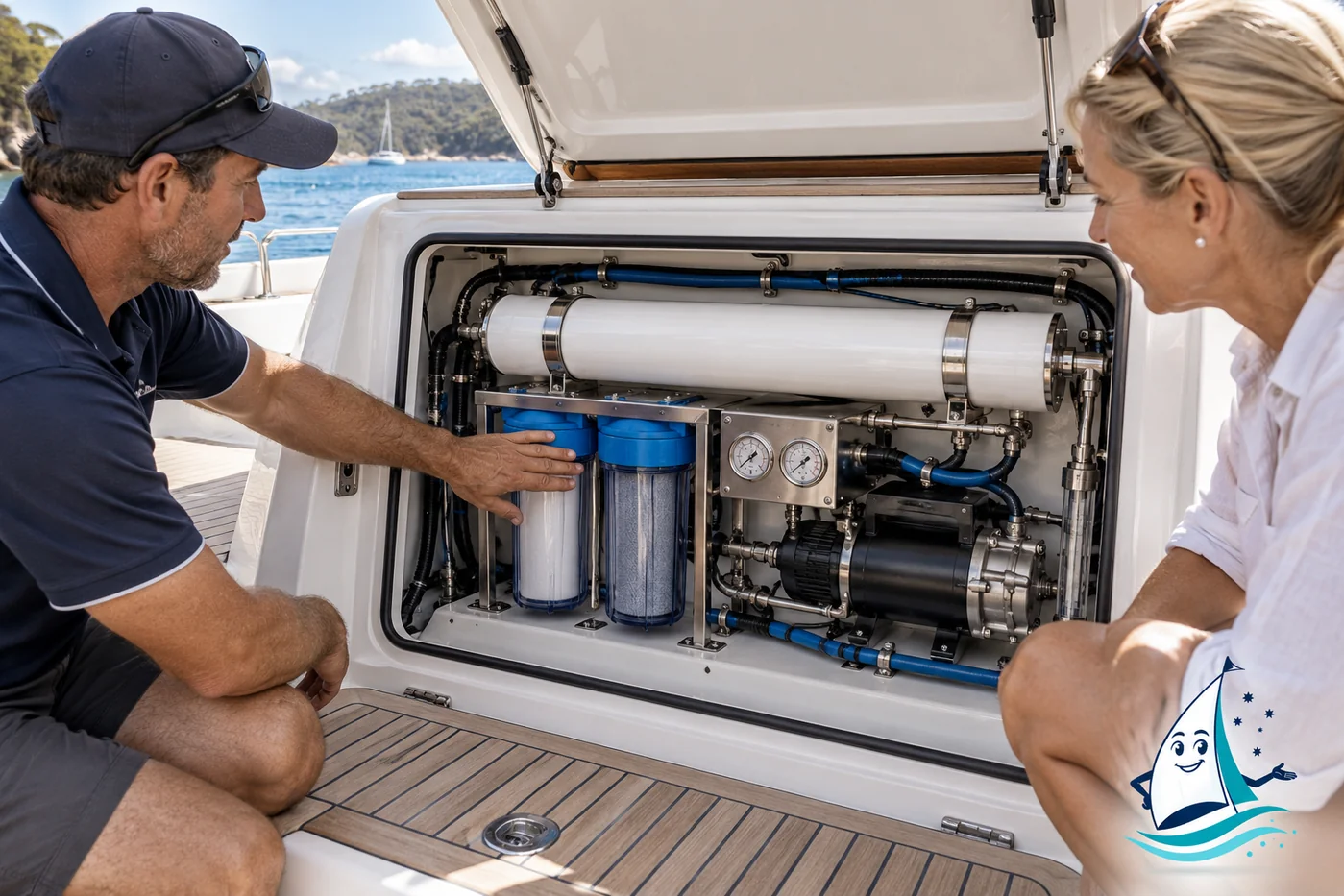
Compare keeping the existing tanks and improving water-use habits, changing storage after a suitable installation assessment, and fitting a watermaker. For a watermaker, compare output under stated test conditions, electrical supply, operating schedule, noise, service access and local support. Ask how expected feed-water conditions affect the selected model rather than treating headline litres per hour as guaranteed production.
3. Check the complete installation
- Ask the installer to inspect proposed intake, discharge, pipework, pumps, controls and membrane locations.
- Confirm access for filter changes, winterising or preservation work as applicable, and eventual component removal.
- Agree the power-supply design and include operation in the yacht’s daily energy budget.
- Discuss product-water monitoring, diversion and acceptance checks for the selected system before water enters the tanks.
- Ask which feed-water situations the manufacturer excludes and what storage or flushing routine fits a yacht used only intermittently.
4. What the all-in quote should cover
Compare written Australian dollar quotes for the same scope. Ask whether GST is included, how long pricing is valid and what remains an estimate.
- Complete unit and controls, any intake/discharge work, pumps, prefilters, hoses and fittings.
- Electrical supply, installation access, tank connections and mounting.
- Consumables, preservation materials, commissioning and owner training.
- Ongoing filter/membrane costs, spares, service support and any flushing-water or power provision.
Equipment-only pricing is not an installed-cost estimate. Record unknown costs separately and agree approval for variations before work proceeds.
5. Check the handover, not just the invoice
Agree the acceptance and commissioning evidence before work starts. Use the installer’s appropriate test procedure; this is an owner’s handover checklist, not instructions to perform technical tests yourself.
- Obtain measured output and power-use records under the commissioning conditions, plus the manufacturer’s required water-quality checks.
- Have start-up, product-water handling, shutdown and fault indications demonstrated.
- Practise the model-specific flushing and storage routine with the installer.
- Keep manuals, service intervals and the consumable/spare-part list accessible aboard.
6. Budget for ongoing ownership
Follow the exact model manual for flushing, approved water sources and preservation. Procedures vary by product and time out of use; do not apply a single internet schedule to every watermaker. Keep service records and an independent water reserve. Arrange advice if output or water-quality indications change.
Common buying mistakes
Do not choose on output alone, place the unit where filters cannot be serviced, assume marina water is always an acceptable feed source, or connect product water without the required checks. A rarely used yacht may need a different maintenance plan from a full-time cruising yacht.
WORKED PLANNING EXAMPLE
Illustrative planning exercise: two people budget 25 litres each per day, or 50 litres total. A unit delivering 30 litres per hour under the actual operating conditions would need about 1.7 hours to replace that use, before allowances for flushing or other consumption. The installer must confirm achievable output, quality checks, energy demand and reserve strategy.
THE OWNER’S FIELD GUIDE
Work through the decision in detail
Use these discussions before requesting a quote. Bring the yacht’s records, your survey findings and a clear description of the trips you want to make.
- Start with the crew’s water habits
- Compare output with a realistic operating window
- Build the electrical and freshwater plans together
- Make routine service physically possible
- Understand flushing, storage and consumables before purchase
- Define water-quality acceptance and owner responsibilities
- Compare ownership effort as carefully as litres per hour
OWNER’S FIELD GUIDE · 01
Start with the crew’s water habits
Record several ordinary days of water use before sizing a watermaker if you can. Separate drinking and cooking from washing, showering and equipment needs. Note how numbers change with guests. A water plan based on two careful owners may not describe a week with four visitors. Include existing tank capacity and where you can reliably refill; a marina-based yacht and a remote cruising yacht have different reasons to consider the equipment.
Ask whether a change in habits, a repair to an existing leak or a reviewed storage improvement solves the problem more simply. The watermaker should earn its place through the trips you actually expect to take. Keep an independent reserve and define what you will do if production becomes unavailable. A unit’s presence on the equipment list is not the same as a dependable supply on every day of a cruise.
OWNER’S FIELD GUIDE · 02
Compare output with a realistic operating window
A catalogue output needs its stated conditions. Ask what output the supplier expects under your likely operating conditions and how that estimate will be checked during commissioning. Then work backwards from daily consumption to approximate running time. Include the other demands on the crew, the electrical system and the yacht during that period. A large unit that is awkward to use may not be the best match for a modest daily requirement.
Discuss when the equipment can appropriately operate and where it should not be used under the manufacturer’s instructions. Do not treat the ability to run at a dock as confirmation that the feed water is suitable. Record the operating restrictions in plain language for the crew, along with the process for accepting or rejecting product water. The owner should know what the system is telling them before sending produced water into storage.
OWNER’S FIELD GUIDE · 03
Build the electrical and freshwater plans together
Give the electrical designer the selected watermaker’s requirements and expected daily schedule. Give the watermaker installer the proposed electrical supply and any constraints on operation. If batteries, solar and a watermaker are being quoted separately, ask who checks that the combined plan works. A water-production calculation without an energy plan describes only half the project.
Consider what other equipment is normally operating at the same time. The relevant professionals should determine compatibility and protection; the owner can help by providing realistic use patterns. Document what happens if the electrical supply is interrupted during operation and what the approved restart process is. Do not infer that a system intended for one supply arrangement can be transferred to another without review.
OWNER’S FIELD GUIDE · 04
Make routine service physically possible
Ask the installer to demonstrate the proposed access for every routine service item before the equipment is fixed in place. Is there room to remove a filter housing, inspect a connection, read the controls and take out a major component later? A compact system can still require considerable working space around it. Discuss noise and vibration where crew will sleep or sit, rather than discovering the effect after installation.
Include the route for hoses and cables in the scope and establish who approves any necessary hull or structural work. Keep photographs of accessible installation details in the handover file. Ask what spares can reasonably be carried and whether the crew can perform the intended owner tasks using the supplied instructions. A serviceable arrangement is a practical ownership benefit, even when it is less visually tidy than equipment hidden behind permanent joinery.
OWNER’S FIELD GUIDE · 05
Understand flushing, storage and consumables before purchase
A watermaker used frequently and one left idle between holidays may require different owner routines. Ask the supplier to explain the selected model’s flushing and preservation requirements for your actual pattern. Request a list of the required consumables, their storage needs and where you can buy them in the areas you plan to visit. Do not rely on a schedule remembered from another brand or model.
Confirm the requirements for water used in any flushing procedure and the manufacturer’s warnings about unsuitable substances. Follow the exact manual and professional instruction; this chapter is not a chemical treatment recipe. Include the cost and effort of returning the unit to service after lay-up in your comparison. If nobody will be available to carry out the required routine while the yacht is unattended, resolve that problem before buying the equipment.
OWNER’S FIELD GUIDE · 06
Define water-quality acceptance and owner responsibilities
Ask the supplier what checks are required before product water is accepted, how the equipment indicates a problem and what actions belong to the owner. Record which monitoring is automatic and which tasks still require a person. Do not equate a clear-looking stream with a completed quality check. Discuss the broader condition and maintenance of tanks and distribution plumbing as part of the water plan.
At commissioning, request the relevant recorded results and an explanation of the conditions in which they were obtained. Have the normal start, diversion or acceptance process, shutdown and fault response demonstrated. Ask what observations should trigger stopping production and contacting support. Keep these procedures easy to find aboard, especially if several people will operate the equipment.
OWNER’S FIELD GUIDE · 07
Compare ownership effort as carefully as litres per hour
Build a comparison with rows for expected output, supply requirements, access, routine tasks, idle-period care, consumables, local service and warranty support. Ask the supplier to distinguish included installation items from assumptions about the yacht. A quoted unit may still need mounting, pipework, electrical work and changes to the storage arrangement.
Include the consequences of downtime in your planning. A yacht near reliable filling points may cope differently from one preparing for an extended remote trip. The reserve and fallback plan remain part of the design conversation even if the watermaker has an excellent reputation. Choose a system you can operate and support, and give the crew time to practise before making it central to the cruising plan.
MAKE A SHORTLIST
Which scope fits your yacht?
Ask the relevant specialist which of these routes is credible for your yacht. Compare the whole result, including the parts you would retain.
PAUSE AND ASK FOR EVIDENCE
Red flags in the upgrade proposal
These are reasons to clarify the scope or seek specialist assessment. They do not establish that a particular product or contractor is unsuitable.
Only the maximum output appears in the proposal
The crew needs useful daily production within the operating time and conditions available on the yacht.
Your next step: Ask which assumptions support expected output, how long production will take and how the energy budget changes.
Filters or membranes cannot be reached for service
An installation can physically fit while creating an impractical maintenance job.
Your next step: Have the installer demonstrate component-removal access and identify any cabinetry that must be moved.
There is no idle-period routine
Seasonal use may involve preparation and care that do not suit the owner’s availability.
Your next step: Obtain the exact model’s instructions and price any professional care needed between trips.
Normal production is the only water contingency
Equipment may become unavailable, and some locations or conditions may be unsuitable for operation.
Your next step: Develop an independent reserve and resupply plan appropriate to the voyage and crew.
ILLUSTRATIVE OWNER SCENARIO
How the decision changes in practice
A crew expects to spend a month away from regular filling points, but their previous trips have been marina weekends. They record consumption over several trial outings, including guests, then build a production and reserve plan. One proposed unit has greater headline output; another has a service arrangement and operating routine that better fit the crew. Before choosing, they ask both installers to describe actual expected output, daily running time, electrical demand, access for maintenance and idle-period care. They purchase only after the complete plan fits the yacht. The useful comparison is supported water availability over the intended trip, not a contest between catalogue numbers.
A fictional planning example, not a report about a particular yacht, owner or contractor.
6 QUESTIONS FOR THIS TOPIC
Watermaker & freshwater capacity: FAQs
Does a larger watermaker always mean less hassle?
Not necessarily. Compare the operating schedule, installation, power supply, maintenance and support alongside production. A bigger unit may suit one crew and create unnecessary complexity for another. Ask the supplier to justify the match to your actual daily requirement.
Can I run it whenever the batteries are full?
Battery condition is only one consideration. Follow the selected unit’s feed-water, operating and maintenance requirements as well as the yacht’s approved electrical design. Agree a usable owner checklist with the installer rather than treating available electricity as permission to operate anywhere.
Can I leave it unused between holidays?
Ask for the manufacturer’s approved idle-period procedure for the exact model and the expected time away. Include who will do the work and what materials are needed. If the routine does not fit your ownership pattern, that is a reason to reconsider the purchase or support arrangements.
Will it replace carrying spare drinking water?
Plan an independent reserve with your intended voyage and crew in mind. Equipment can become unavailable or unsuitable to operate. Discuss the overall water plan with the appropriate professionals and do not make normal production your only response to an interruption.
Should I connect it directly to my existing tank?
The installer needs to assess the complete arrangement, including product-water acceptance, storage and distribution. Do not bypass the required checks or improvise a connection based on a photograph. Ask for the final plumbing arrangement to be documented and demonstrated.
What should I compare between quotes?
Match the unit and controls, mounting, intake and discharge work, supply wiring, filters and consumables, commissioning and training. List exclusions separately. A lower equipment price may not remain lower once the same installation responsibilities are included.
Manufacturer reference
Spectra: choose the manual for your watermaker ↗
Consult the current manual for the exact chosen model. This reference illustrates the planning issues; it is not a brand endorsement or confirmation of Australian compliance. Research checked 6 October 2026.
YOUR INSTALLER BRIEF
Prepare your watermaker & freshwater capacity enquiry
Saved only in this browser. Print a copy before clearing browser data. These notes stay with this equipment guide on this device; nothing is sent to a contractor.