
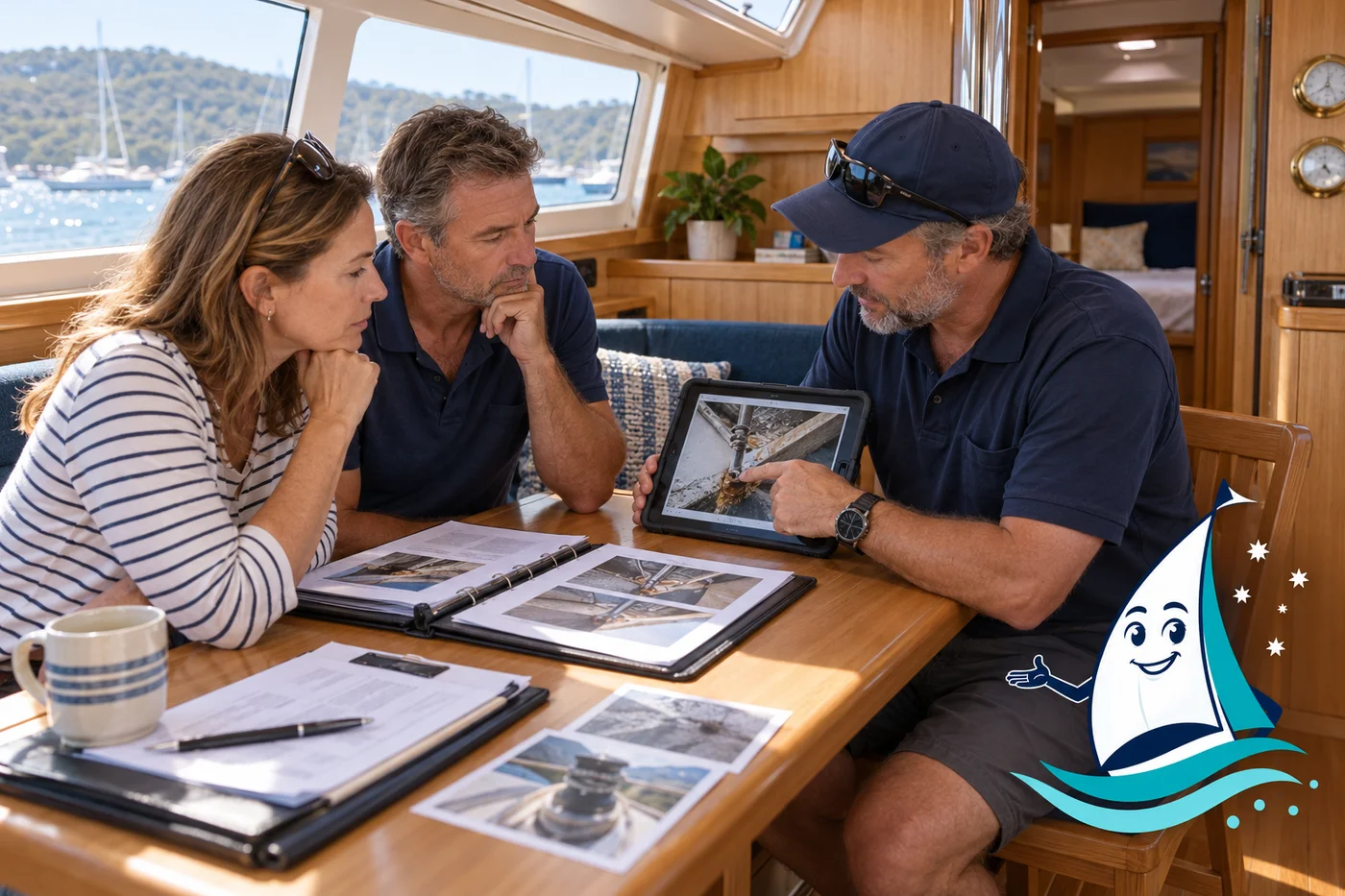
The short answer
The number of findings matters less than their consequence, certainty and practical repair path.
What you’ll work through
Read the scope before the conclusion
Start with what was inspected, the conditions and the exclusions. A report can be thorough within its scope and still leave important questions unanswered. List inaccessible areas and equipment that was not operated. Ask the surveyor to explain whether those limitations justify further access or specialist work for your intended use.
Then read the findings with the yacht's service records alongside them. Do not reduce a long report to a count of defects. Ten inexpensive maintenance tasks and one unresolved structural concern are not comparable simply because both appear as bullet points.
Separate four kinds of action
Create categories for significant concerns before use, further investigation, scheduled maintenance and optional improvements. Ask the professionals to help classify findings where needed. Keep the report's original wording alongside your summary so an uncertain observation does not become an invented diagnosis as it moves into the spreadsheet.
For each item, name the responsible specialist, the next action, access requirements and a decision deadline. If a concern cannot be priced until disassembly, label it investigation rather than assigning a reassuring guess. This is especially important when the proposed discount appears large but the eventual repair scope remains open.
Obtain quotes against the actual findings
Send the relevant report extract and photographs to a suitable repairer, with permission where needed. Ask whether they need to see the yacht before quoting. Include parts, labour, lifting, access, reassembly, commissioning, taxes and yard time in the comparison. Record exclusions and quote validity.
Avoid adding several quotes together when they cover overlapping work. Equally, do not omit coordination tasks because every contractor assumes someone else is doing them. A repower, electrical change and interior alteration may affect one another. Choose who will manage the overall programme if you proceed.
Revisit suitability and insurance
Compare the revised work list with your original sailing brief. If the yacht cannot be ready when you intend to use it, ask whether that changes its value to you. Consider the availability of the required skills and work location. Your time and appetite for organising repairs are real constraints, even when the arithmetic is affordable.
Discuss relevant findings with the proposed insurer and clarify any requirements in writing. Do not assume an existing policy will carry over or that a verbal comment from someone at the yard establishes cover. Insurance and registration questions should be resolved alongside the technical decision, not left until after settlement.
Make the decision through the agreed process
You may proceed, seek clarification, propose amended terms or decide not to continue, depending on the agreement. Track notice requirements and deadlines and get legal advice when needed. A report does not automatically create a cancellation right or require the seller to pay every repair bill.
If you buy, turn the agreed work into a dated owner action plan and retain reports and completion evidence. If you do not, keep the lessons for the next shortlist. The cost of learning that a yacht is unsuitable can be far smaller than the cost of owning the wrong yacht.
Make a findings register you can close
Give each significant finding a reference, location, consequence, recommended action, responsible specialist, quote status and evidence needed for closure. Copy the report’s level of certainty accurately. “Investigate” is not the same as “replace”, and an excluded area is not a clean result. Ask the author to explain ambiguous language before turning it into a repair instruction.
Sort findings into work before use, work needed for intended use or cover, scheduled maintenance and optional improvements. Ask professionals to determine technical priority. Then compare the programme with your budget and available time. Obtain a clear answer about who will verify completed work. Closing a spreadsheet row because someone paid an invoice is different from establishing that the original recommendation has been addressed.
Turn each recommendation into a closed action
Build a table containing the exact recommendation, location, responsible specialist, next evidence, quote and completion record. Separate urgent action, further investigation and planned maintenance according to the report and subsequent professional advice. Avoid translating every observation into either “minor” or “deal breaker”; some findings remain uncertain until access or testing improves.
If a seller offers to arrange repairs, agree the scope and how completion will be independently checked where appropriate. An invoice saying “repairs completed” may not answer the original recommendation. Preserve photographs, test results and written acceptance alongside the report. The aim is a traceable resolution, not merely a shorter list of open items.
Put the advice to work
Read what the report did not establish
Illustrative report wording: “Moisture readings elevated beside a deck fitting; core condition not established; further investigation recommended.” This is a finding with a limitation, not a repair specification.
| Check | What you have | What to do with it |
|---|---|---|
| Observed | Elevated readings in a named area | Keep the marked location and inspection conditions with the report. |
| Not established | Extent and cause of any concealed damage | Do not turn an unanswered question into either a clean bill of health or a confirmed structural diagnosis. |
| Follow-up | Surveyor specifies appropriate investigation | Obtain owner permission, access arrangements and the cost of that investigation. |
| Decision | Repair scope is still unknown | Resolve the uncertainty within your actual purchase conditions, or obtain legal advice about the options before a deadline passes. |
The decision: A contractor cannot reliably price an undefined repair merely because a report contains a recommendation. Keep investigation, repair and verification as separate tasks.
Further reading: AIMS: pre-purchase versus insurance surveys ↗. The example is editorial interpretation, not a finding about a real yacht or a professional sign-off.
Follow a complete Buyer’s File →FROM OBSERVATION TO ACTION
What the answer means
| What you encounter | What it means | Your next action |
|---|---|---|
| “Further investigation recommended” | The question remains open. | Ask what access and specialist work will resolve it. |
| A contractor proposes a different remedy | The scope may not match the recommendation. | Have the relevant professionals clarify it. |
| Several small findings share one access job | Sequencing could change cost and downtime. | Request a coordinated work scope. |
A BUYER’S DECISION
Work through an example
Illustrative finding: further investigation is recommended behind an inaccessible fitting. The buyer’s first budget had assumed a small repair. After discussing access, they replace that guess with an investigation stage and a decision point for additional work. The purchase decision now reflects unresolved scope instead of a falsely reassuring fixed total.
6 QUESTIONS FOR THIS TOPIC
Turn survey findings into a decision: FAQs
Should every finding reduce the price?
No. Separate actual condition, expected age-related maintenance, your preferences and what the agreement provides. Use evidence to make a reasoned proposal.
What if I disagree with the report?
Ask the author to explain the evidence and scope. Seek a suitable second opinion on a defined issue rather than shopping for a reassuring conclusion.
How do I distinguish urgent repairs from optional improvements?
Ask the report’s author to explain priorities in relation to your intended use, including any work needed before operation. Keep condition findings separate from personal upgrade preferences. Then obtain specialist scopes and quotes for the items that affect your decision.
What should I do with a survey item marked not inspected?
Find out why access or testing was unavailable, what uncertainty remains and how it can be resolved. Do not treat the entry as a pass. Consider whether the unanswered question changes your willingness to proceed before committing to further costs.
How do I turn a survey recommendation into a contractor’s quote?
Give the contractor the relevant finding, yacht details and access information, then ask for a defined investigation or repair scope. A recommendation is not always a complete repair specification. Record any assumptions, exclusions and further assessment needed.
Can the seller’s repair invoice close a survey finding?
Ask the surveyor or relevant specialist what evidence or follow-up inspection is appropriate. An invoice records billed work, but may not answer the original finding by itself. Agree how satisfactory completion will be established before relying on the repair.
Before you move on
Your questions, answered
Tick a question when you have recorded an answer or assigned a follow-up. A tick records your progress; it does not certify the yacht.
Saved only in this browser. Print a copy before clearing browser data.
0 of 4 questions addressed
Record your evidence in the buyer’s notebook →
YOUR AUSTRALIAN SUPPORT CREW
Find the right help on YouSail.
Start with the job you need done, then discuss experience, scope and availability directly.
INDEPENDENT PRE-PURCHASE ASSESSMENT
Marine surveyors ↗Commission an independent assessment.
Explore the YouSail directory →Scope structural repairs and coordinated yard work.
Explore the YouSail directory →Directory links checked 6 October 2026. Listings are starting points for enquiries, not endorsements or confirmation of current qualifications, services or availability. Choose and appoint your own independent professionals.